Systems translators
Decisions cross different languages. A technology project involves interests, rules, resources and timelines that rarely coincide: the work lies in connecting skills and making decisions workable.
Four languages and a fifth.
The technical, economic, political and institutional languages have to find common ground. Code adds a further layer: rules and decisions can be embedded in algorithmic systems.
Digital transformation is first and foremost a question of governance. Technology comes second. It is the thread that runs through my experience across healthcare, business, public administration and institutions.
- Technical
- Economic
- Political
- Institutional
- Code
The AIR-T model
A grid for reading the interests and constraints that shape decisions in complex systems.
- A
- Actors
- I
- Incentives
- R
- Rules
- T
- Time
Three steps
The method by which a technology choice becomes a result.
Understand
Identify the actors, the constraints and the problem to be solved.
Connect
Bring technical, economic and institutional languages into relation.
Deliver
Translate decisions into processes, responsibilities and verifiable results.
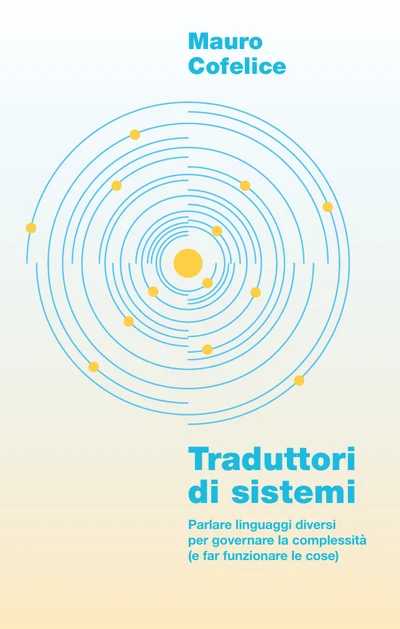
The book
Traduttori di sistemi (Systems translators). Speaking different languages to govern complexity (and make things work).
The book addresses the difficulty of holding together technical, economic, political and institutional languages when decisions are made about technology and organisations. It is structured in eighteen chapters and three movements: speaking the language, governing complexity, designing artificial intelligence.
Unpublished manuscript, in Italian. No publication date announced.